
How Tire Condition Affects Safety, Fuel Use, and Long-Term Costs
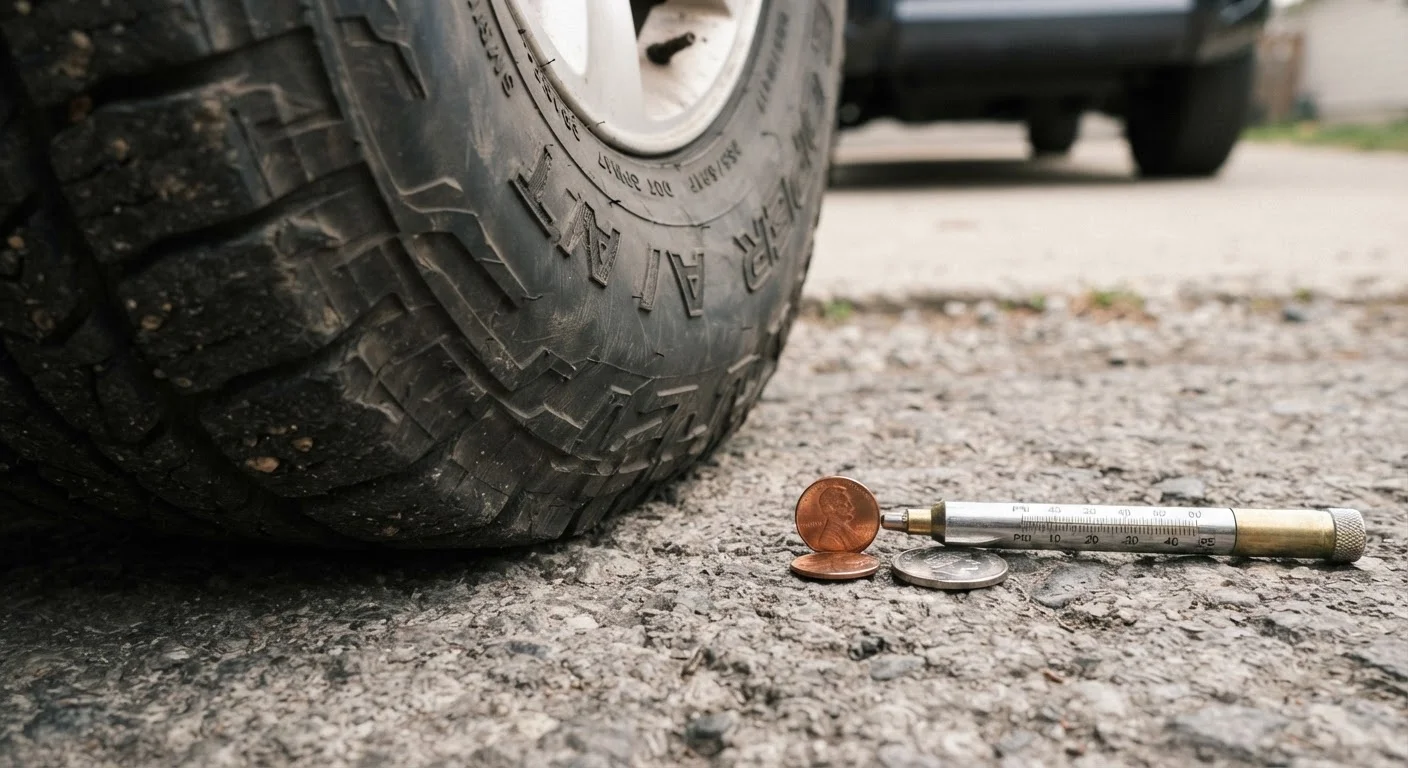
Photo credit: simplefuture.net
In this article
Worn or improperly inflated tires do more than create a safety hazard. Learn how tire health quietly affects your family's driving budget.
Key Takeaways
- Under-inflated tires can reduce fuel economy by roughly 0.2% for every 1 PSI drop across all four tires.
- Tires worn below 4/32" tread depth stop water significantly more slowly than new tires.
- Misaligned or unbalanced tires wear unevenly and may need replacing far sooner than expected.
- Tire rotation and correct inflation are low-cost habits that extend tire life by thousands of miles.
- Replacing one worn tire instead of a full set can create handling imbalances and cost more over time.
Why tire health is a financial issue, not just a safety one
Most drivers think about tires only when something goes wrong: a flat, a blowout, or a warning light. By that point, the tire has often already cost money in ways that went unnoticed. Poor tire condition affects how much fuel your vehicle burns, how quickly the tires themselves wear out, and whether your brakes and suspension take on extra stress.
For a family running one or two vehicles, the compounding effect of neglected tires is real. A tire that is 10 PSI under-inflated does not just pose a blowout risk on a highway. It forces the engine to work against greater rolling resistance every mile you drive. The US Department of Energy estimates that keeping tires at the correct pressure can improve fuel economy by up to 3%, which translates to dollars saved at the pump over a full year.
If fuel costs are already a concern for your household, see common fuel economy misconceptions for a broader look at what actually moves the needle on gas mileage.
Check tire pressure when tires are cold
Tire pressure readings change with temperature: driving heats the air inside the tire and raises the reading. Check pressure before you have driven more than a mile for the most accurate result. Your vehicle's recommended PSI is printed on a sticker inside the driver's door jamb, not on the tire itself.
How tread depth affects stopping distance and wet-weather grip
Tread channels are what move water out from under a tire as you drive. When those channels are shallow, water has nowhere to go, and the tire rides on a thin film instead of gripping the road. This is called hydroplaning, and it happens faster than most drivers expect.
The NHTSA has published data showing that tires worn to 2/32" tread stop in wet conditions in significantly longer distances than tires at the legal and functional standard. A tire at 4/32" is already meaningfully worse in rain than one at 6/32" or above. Stopping distance in an emergency is not an abstract concern: at highway speeds, the difference of even a few feet can change an outcome.
The penny test is a common quick check: insert a penny into the tread groove with Lincoln's head facing down. If you can see his full head, the tread is at or below 2/32" and the tire is at or near the legal minimum. The quarter test (which signals 4/32" depth) gives you earlier warning before conditions become critical.
Up to 3%
Fuel economy gain from correct tire pressure
According to the US Department of Energy, keeping tires properly inflated can improve gas mileage by up to 3%.
0.2% per PSI
Fuel economy loss per underinflated PSI
The US Department of Energy estimates gas mileage drops about 0.2% for every 1 PSI below the recommended level across all four tires.
2/32"
Minimum legal tread depth in most US states
The NHTSA sets this as the federal guidance floor, though wet-weather performance declines measurably before this point is reached.
Alignment, balance, and uneven wear
A tire that is out of alignment or unbalanced wears unevenly. One section of the tread takes more load than it should, and that area degrades faster. The tire may look fine overall while one edge is already approaching the wear limit. You end up replacing tires earlier than the mileage rating would suggest.
Wheel alignment also affects fuel economy. A vehicle that is pulling even slightly to one side is fighting itself, and the engine burns more fuel compensating. Alignment checks are typically inexpensive and can be done during a routine tire rotation. For a broader look at how skipping these small services adds up, see what deferred maintenance actually costs.
Tire rotation, generally recommended every 5,000 to 7,500 miles, moves tires between positions to even out wear patterns. Front tires on front-wheel-drive vehicles carry both steering and power loads and wear faster than rears. Rotating them regularly can add thousands of miles to a set of tires.
The real cost of waiting too long
A single tire replaced in isolation creates a mismatch. Mixing a new tire with three worn ones can cause handling differences and put stress on the drivetrain, particularly on all-wheel-drive vehicles where tires must stay close in circumference. Some AWD systems can sustain damage if tires differ significantly in tread depth, which turns a $150 tire replacement into a much larger repair.
Tire sets that wear out prematurely because of neglected rotation, persistent under-inflation, or ignored alignment problems are a hidden part of the cost of vehicle ownership. Those costs are easy to miss when you only look at the sticker price of new tires and not at how often you are buying them. The relationship between maintenance and vehicle value follows a similar logic: small deferred costs tend to grow.
For families planning longer drives, tire condition also matters when calculating whether a road trip is actually affordable. See road trips on a tight budget for how vehicle readiness fits into overall trip costs.
This article is for general informational purposes only and does not constitute professional mechanical or financial advice. Consult a qualified mechanic for guidance specific to your vehicle.
Frequently Asked Questions

Author
Auto Editorial Team
Auto Editorial Team is the collective byline for our editorial team and contributor network. Articles published under this byline or an editorial pen name are researched, written, and reviewed according to our editorial standards for clarity, consistency, and independence before publication.
View all articles →